
The Community Curriculum
How it works
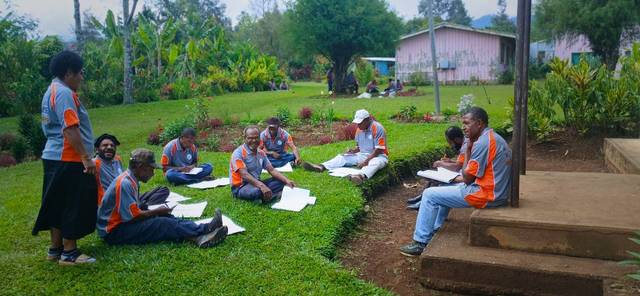
Local facilitators bring people together for seven weekly sessions of discussion and practical activity. Between sessions, the facilitators meet to prepare, reflect and support each other. Public ceremonies mark completion and make the community’s support visible. The community itself is the setting of change.
Three strands of the approach
Question harmful explanations
Participants examine accusation stories and the explanations behind them, and ask what evidence supports them: “Big stories need big evidence.”[2]
Act protectively
Participants practise roles such as protector and truth-teller: protecting others, challenging harmful stories and seeking help. The course connects these roles with PNG law and the moral language of faith.[2, 12]
Stand together
Weekly facilitator meetings, connections between neighbouring groups and public graduations help make support visible. People need to know who will stand with them when an accusation arises.[12]
People need reasons to reject accusations and relationships that support them in acting differently. The programme works on both together.[12, 29]
Making room to question familiar beliefs
Pastors, parents and community leaders can help transmit the stories behind accusations. Their relationships and responsibilities also give them a part in changing those stories. Facilitators work among people who already know them, bringing history, evidence, Christian teaching and PNG law into the conversation.[12, 29]
Groups of about twenty are intended to give everyone room to speak and to limit speechmaking and domination. Host leaders invite people across churches, clans, factions, ages and genders. Shared food, fellowship, prayers and devotions connect the sessions with community life. Repeated meetings give people time to think, discuss and reconsider together.[29]
Neighbouring groups learn alongside one another, and local facilitators bring networks that will outlast the course. Public graduations make that wider support visible. These are deliberate ways of helping people question harmful beliefs without leaving them to stand alone.[12, 29]
Tending the garden
A garden gives participants a familiar way to discuss the community they want to care for. Harmful ideas are weeds: “These weeds are not people. The weeds are bad ideas.” The metaphor makes room to challenge an accusation while respecting everyone’s dignity.[2]
The garden, in five practices
- Good soilTrusted local facilitators invite people to consider how they can contribute to their community's wellbeing. Participants practise roles such as protector and truth-teller.[12]
- Pull the weedsSmall groups examine sorcery stories and ask what evidence supports them. Harmful claims can be questioned while respecting people's dignity.[2]
- Tend it every weekRepeated sessions allow discussion and reflection. Facilitators meet each week to prepare, debrief and support one another.[12]
- Mend the fenceCommunity wellbeing, shared religious convictions and PNG law give people grounds to question accusations and protect those accused.[2]
- Connect the gardensPeer networks and public recognition help people identify others who will stand with them.[12]
Seven areas of learning
- Understanding SARV: our soil is good soil
- Human rights and legal literacy: taking care of the garden fence
- Community agency: people's capacity to act together to protect others
- Conflict resolution and mediation: keeping peace in the garden
- Care for survivors: healing and support
- Youth leadership: the new shoots in the garden
- Faith-based engagement: what does God want us to do?
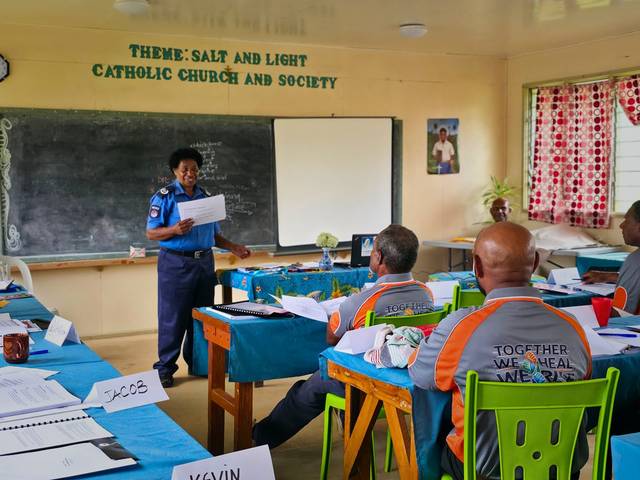
The team refined the material during the 2025 trial, simplifying it and building weekly preparation and coaching around local facilitators. Simple English, visual handouts, role play and familiar language make the sessions accessible to people with different levels of literacy.[2, 12]
How a delivery group works
- A church or community partner appoints a coordinator for a delivery group, called a cohort. Each cohort is intended to serve about twelve community sites.[3]
- The coordinator recruits about eighteen local facilitators, who are trained together over several days before the community phase.[3, 21]
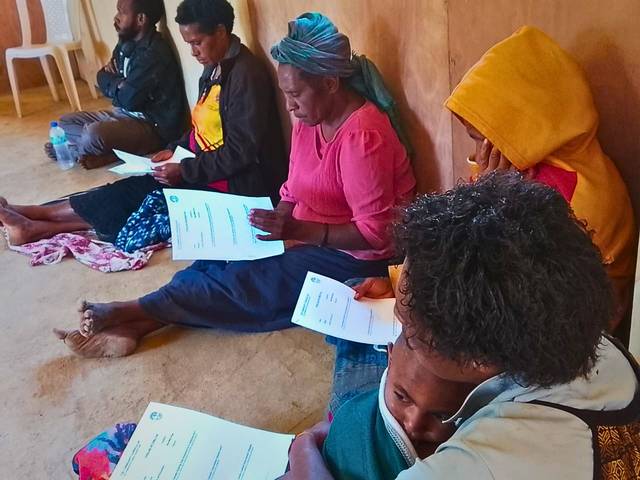
- Facilitators work in small teams and deliver seven weekly sessions at each site, often with shared food and fellowship.
- Facilitators meet every week to prepare, report and support one another.
- Participants complete a short written survey before the first session (baseline) and after the last (endline).
- A public graduation marks the end of the course. In the 2025 trial, these ceremonies also helped counter suspicion and showed participants that local leaders and institutions supported them.[12]
Schedules varied across the twelve 2026 cohorts; see Where.
Why work through churches
PNG is a predominantly Christian country. In many Highlands communities, churches offer trusted relationships, meeting places and a shared language for discussing responsibility. During the 2025 trial in Enga, facilitators brought Christian teaching together with PNG law and familiar metaphors to explore truth and care. Their training encouraged discussion and questions rather than preaching.[12]
The programme connects Christian vocation with care for neighbours, truthfulness and responsibility for community wellbeing. Participants are invited to see themselves as protectors and peacebuilders, with a part to play in changing the stories and practices around them.[12, 29]
Protection alongside prevention
People at risk still need emergency help, legal protection and survivor care, and prevention must support those responses. Protection is unconditional, whatever anyone believes about the person at risk. Prevention work should respect survivors’ choices, privacy and dignity, maintain safe routes to help, and preserve accountability for violence.[2, 7, 13]
Building on existing practice
The curriculum draws on consultation in PNG and earlier work on faith, evidence, storytelling and community responses, including Heart of the Matter, Kapori research, Philip Gibbs, and Miranda Forsyth and Fiona Hukula.[13, 14, 15, 16, 17] It brings these influences into a supported programme of repeated learning and local leadership.