
Sources and downloads
Sources and downloads
Download the poster and curriculum, or follow the sources behind the programme and findings.
Downloads
SVRI 2026 posterPDF, A0, 4.6 MB
Poster preview imageJPG, 0.4 MB
Participant bookletPDF, 12 pages, 1.4 MB
Community Curriculum, simple English versionPDF, 83 pages, 21 MB
Wokman Bilong God, for church leadersPDF, Tok Pisin, 0.7 MB
No One Should Stand AlonePDF, 4.6 MB
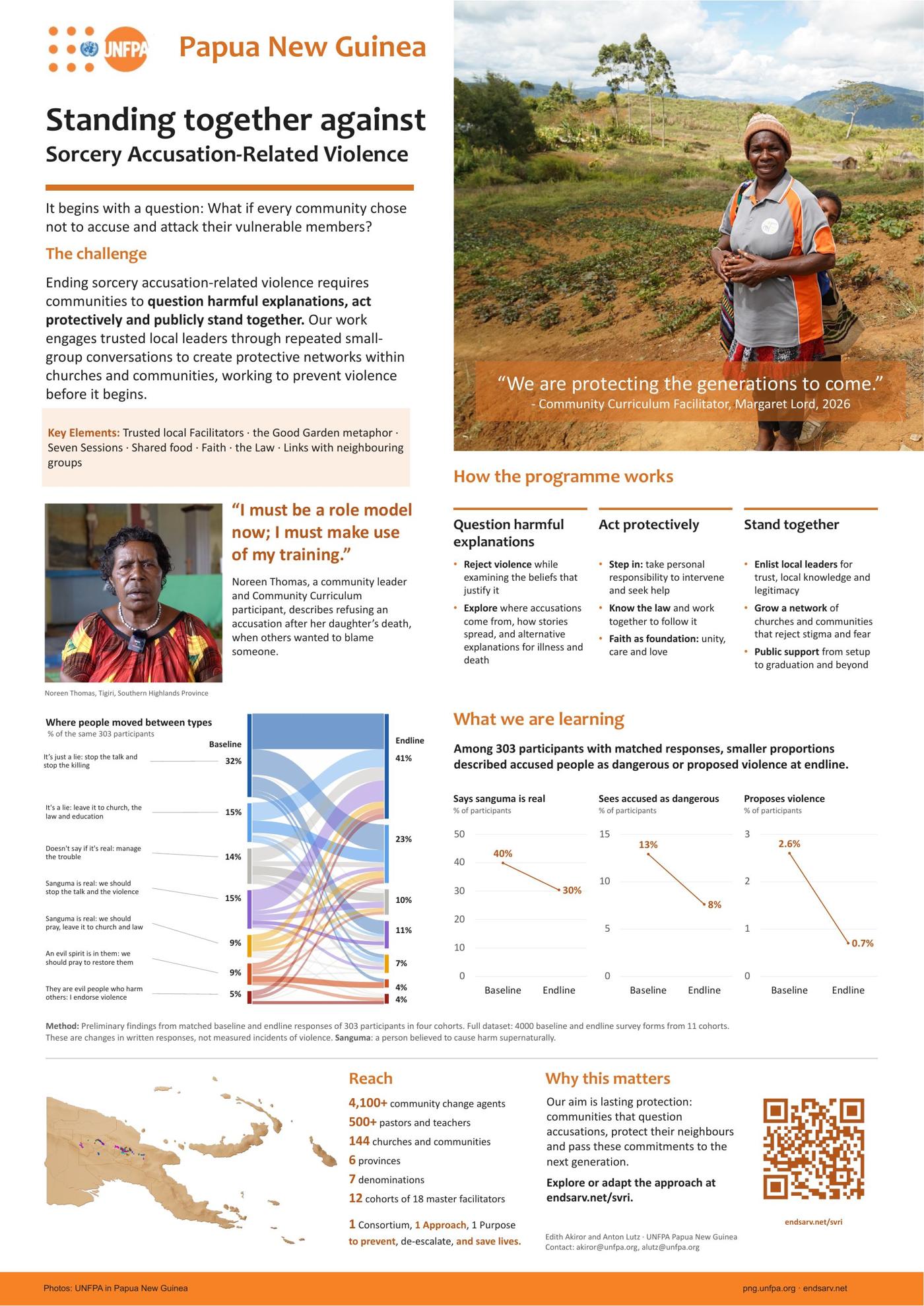
On a slow connection, start with the participant booklet. Simple English curriculum: corrected edition, 30 September 2026.

References
Numbers in square brackets on each page link here. Unpublished programme records are identified below. Contact the programme team with questions about the evidence.
- Lutz, A. (2025). Transformational Education for Change: Tools to End Sorcery Accusation-Related Violence in Papua New Guinea. Social Change Initiative implementation report, Rotary Peace Center, Makerere University. Implementation and results pp. 21 to 24. Unpublished programme record.
- Divine Word University (2025). Community Curriculum on SARV: English as a Second Language version and handouts. UNFPA PNG. Section 1: garden metaphor, terms and evidence prompts. Open
- Community Curriculum programme team (2026). CC Programme Master Overview, draft, 2 May 2026. Programme design and cohort roster. Unpublished programme record.
- Divine Word University and UNFPA PNG (2025). No One Should Stand Alone: Towards a Unified Response to Sorcery Accusation Related Violence. Background research on SARV, not an evaluation of the Community Curriculum. Patterns of accusation and victimisation pp. 7 to 14. The research team included Anton Lutz. Open
- Papua New Guinea. Criminal Code (Amendment) Act 2013, inserting s.299A; Criminal Code ss.319 and 335; Sorcery (Repeal) Act 2013. Open
- Constitution of the Independent State of Papua New Guinea, ss.35 and 36. Open
- Divine Word University (2025). Community Curriculum, full version. UNFPA PNG. The foreword links the curriculum to the community awareness and prevention outcome of the national SARV action plan. Open
- Lutz, A. (2026). August 2026 progress report to UNFPA: Community Curriculum rollout, Lower Asaro graduation, continuation at Gena, Peter & Grace teacher interviews. Unpublished programme record.
- Akiror, E. and Lutz, A. (2026). Standing together against Sorcery Accusation-Related Violence. Poster, SVRI Forum 2026, Bangkok. UNFPA Papua New Guinea. Download
- UNFPA PNG (23 July 2025). How communities in Enga Province are rewriting the narrative on sorcery-related violence. Open
- endsarv.net. Our Communities: delivery roles and partner names. Open
- Lutz, A. (22 August 2025). Final Report: The Trial of the Community Curriculum. Prepared for Divine Word University. Design and delivery pp. 5 to 13; accounts and surveys pp. 17 to 22; public recognition pp. 23 to 25; interpretation pp. 26 to 35. Unpublished programme record.
- Lutz, A. (22 October 2024). Empowering Communities: A Path to Ending SARV in PNG. Desktop literature review. Review informing programme design. Unpublished programme record.
- Stop Child Witch Accusations coalition, with CAAES, Democratic Republic of the Congo (2018). The Heart of the Matter facilitator's guide. Open
- Witne, B. D., Thomas, V., Kauli, J. and Spurgeon, C. (2023). Kapori: Researching local responses to sorcery accusation-related violence in Papua New Guinea through Indigenous storytelling. AlterNative, 19(4), 814 to 823. doi:10.1177/11771801231197822. Open
- Gibbs, P. J. (2023). Postmodern Faith Response to Sorcery Accusations in Papua New Guinea. ASPAC MER, 1(1). Open
- Forsyth, M. and Hukula, F. (2018). Challenges and strategies in conducting training and awareness on sorcery accusation-related violence, parts one and two. Devpolicy Blog. Open · Part two
- Community Curriculum survey analysis (29 September 2026). Matched before-and-after comparisons and exploratory patterns of responses. Unpublished programme record.
- Community Curriculum unique participant count (29 September 2026). Protocol, evidence by cohort and calibration from the Hela (Tari) register. Unpublished programme record.
- Community Curriculum cohort journey reports, Q3 2026 (September 2026), prepared for the KOICA reporting cycle, and the coordinators' WhatsApp records they draw on. Unpublished programme record.
- Gibbs, P., Kipongi, W., Lutz, A. and others (2021). Sorcery Accusation-Related Violence (SARV) in Enga Province. PNG National Research Institute, Issues Paper 37. Table 1: victims of violent incidents, January 2016 to June 2020 (n = 149, 96% female); 285 of 307 accused were women. Open
- Papua New Guinea. Criminal Code (Amendment) Act 2022 (No. 14 of 2022), which added Division 4, sections 520A to 520G (acting as or using a glasman or glasmeri; section 520E, accusation of sorcery). Linked text: Criminal Code Act (Chapter 262), consolidated to 22 July 2024, PacLII. See also the judgment at [25]. Open
- The State v James Mon, National Court of Justice, Bulolo. Guilty plea entered 15 October 2024; sentence delivered 12 March 2025. Open
- Community Curriculum methodology note and surveys (April 2026): oral consent procedure in Tok Pisin, data handling and safeguards. Documented survey procedure. Unpublished programme record.
- Community Curriculum survey findings and method: two readings of the same surveys (30 September 2026, version 2, preliminary). Tok Pisin coding (codebook v1.7) and English coding (fresh codebook, criteria set before coding); convergence estimates with bootstrap intervals. Unpublished programme record.
- Lutz, A. (22 September 2026). Programme design in Papua New Guinea: design account, version 0.1. Programme purpose, twelve design choices and long-term vision. Unpublished programme record.
Key terms
- SARV
- Sorcery accusation-related violence.
- Tok Pisin
- A widely used language in Papua New Guinea.
- Sanguma
- A Tok Pisin word now widely used for a person believed to cause harm physically, supernaturally or through an invisible being or spirit said to live inside them.
- Giaman
- False, a lie.
- Glasman, glasmeri
- People said to identify a sorcerer.
- Cohort
- A delivery group: one partner, one coordinator and its facilitators, serving about twelve community sites.
- Baseline, endline
- The surveys before the first session and after the last.
- Matched participants
- People whose baseline and endline forms have been linked, so change can be measured within the same person.
- Graduation
- A public ceremony marking completion of the course; not an academic qualification.