
Gender, power and protection
Gender and power in sorcery accusations
Women face particular risks from sorcery accusations, including sexual violence. The programme works with the communities whose beliefs and actions can sustain that harm, and whose members can choose to question accusations and protect one another.
Who is harmed
In Enga Province, recorded incidents from January 2016 to June 2020 show that 96% of the 149 people subjected to serious physical violence were female. This is evidence from one province; patterns vary elsewhere in PNG.[22]
No One Should Stand Alone describes how accusations interact with local beliefs and a person's position within the community. Older women, widows, divorced women and women without adult sons to protect them are frequently targeted. Men and children are also accused and attacked.[4]
Attacks on women can include rape, public stripping and sexualised torture. Participants' accounts also bring this into view: at least 26 survey forms from 14 sites describe sexual violence, although the survey did not specifically ask about it. These are accounts of experiences, not a measure of prevalence.[4, 18]
What participants describe
The survey asks whether participants have seen someone accused in their community and what happened. Of 1,622 baseline forms, 86% describe an accusation or violence locally.[18] Among the 496 forms that identify who was accused:
These percentages refer to forms, not separate incidents. A form can describe more than one person, and several writers may describe the same event. Of the 388 endline forms identifying who was accused, 58% name a woman and 31% a man.
At baseline, 60% of women respondents’ accounts named a woman but no man, compared with 45% of men respondents’ accounts. The same pattern appears at endline.[18]
Preliminary findings from the 29 September 2026 analysis.
Working with the wider community
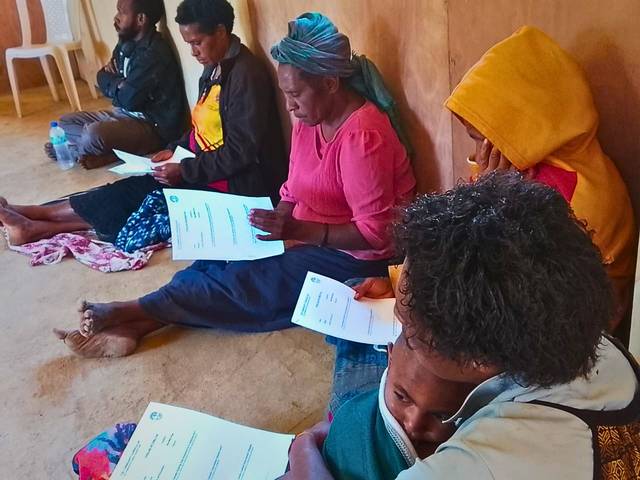
Accusations can draw relatives, neighbours and leaders into public violence. The curriculum asks people to examine the stories that make an accusation convincing and the responsibilities they have towards those at risk. People need reasons to reject the accusation and others who will stand with them.[2, 4, 12]
Women and men take part in this work as participants, facilitators and leaders. Noreen Thomas describes refusing an accusation after her daughter's death; facilitator Margaret Lord speaks of protecting the generations to come. Read their accounts →[9]
Who leads, and who takes part
Most facilitators are recruited from pastors and community leaders. Women were 23 of the 175 facilitators whose sex was recorded across ten delivery groups, and two of the twelve coordinators. In Hela, women were 63% of the 398 named participants.[21] Strengthening women's leadership is a priority.
Survivors of accusations spoke during sessions in Gumine, Wabag and Tabare, and some facilitators described having been accused themselves. Their experiences bring the consequences of accusations into the learning.[21]
Protection is unconditional
No accusation justifies violence, and nobody should have to prove their innocence to receive protection. The curriculum teaches the law and where to seek help. The programme does not operate safe houses or counselling services.[2, 21]
An urgent move chosen by someone at risk can save their life. Forced exile or confinement can cause further harm, separating people from family, land and livelihood. Protection must respect the person's choices and longer-term safety.