Background
What is sorcery accusation-related violence?
Harm directed at people accused of causing misfortune through sorcery or witchcraft. Illness and death can trigger accusations, and disputes, jealousy and struggles over resources can also play a part. Patterns differ between communities and provinces.[4]
The setting
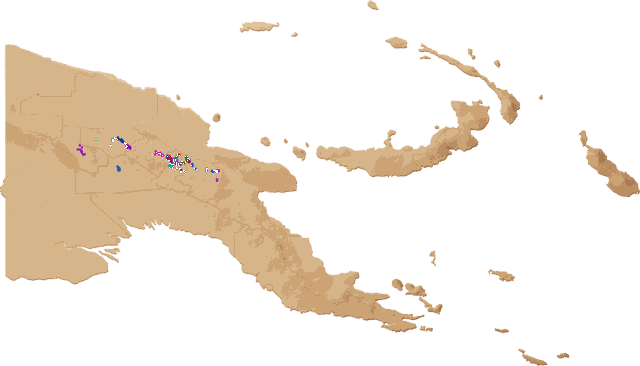
Papua New Guinea is a Pacific country north of Australia, with over 800 local languages. The Highlands are its mountainous interior: densely settled valleys, mostly rural, where church and clan relationships shape daily life. The programme works in six of the seven Highlands provinces, PNG's main subnational administrative areas.
Tok Pisin (Neo-Melanesian Pidgin) is a widely used language across PNG. The curriculum and its surveys use Tok Pisin alongside simple English, and several local terms matter because they do not translate neatly.
Three words
The Community Curriculum explains SARV one word at a time.[2]
Sorcery
Sorcery is an English word, introduced during the colonial period and later applied to many different local beliefs and practices, whether or not they involved the supernatural. In Tok Pisin, sorcery is often translated as posin, from the English “poison”. In the context of SARV, the word sorcery covers practices, powers or persons blamed for causing harm. Another Tok Pisin word, sanguma, is now widely used for a person believed to cause harm physically, supernaturally or through an invisible being or spirit said to live inside them. Other terms also matter: glasman and glasmeri are people believed to be able to identify a sorcerer or sanguma. The curriculum invites participants to examine where these terms come from, how their meanings have changed, and what claims are attached to them.[2, 4]
How accusations become harm
Three Tok Pisin terms from the curriculum help people discuss how harmful ideas and stories can lead to violence. The framework connects the ideas people hold, the stories they repeat and the actions they take.[2]
- Tingting nogutHarmful ideas and beliefs. For example: the belief that someone can be identified as a sorcerer, forced to confess through torture, and then killed, dismembered or otherwise punished. The curriculum asks participants to examine these ideas before they become rumours or action.
- Toktok nogutRumours, gossip and accusations. The more these stories are repeated, the more they can seem true, even when no evidence supports them.
- Pasin nogutHarmful action. This can include blaming, threatening, chasing someone away, assault, torture or killing. It can also escalate into revenge, wider community conflict, tribal fighting or damage to services.
Gender, power and protection
Women face particular risks, including sexual violence, while men and children are also accused and attacked. Patterns vary across provinces and communities. The public and collective nature of many attacks makes the wider community central to prevention.[4]
Read No One Should Stand Alone (PDF, 4.6 MB), research on accusations, violence and responses in PNG.

Beliefs are not fixed
Beliefs differ within and between communities, and they change over time. Many people already question accusations and defend those at risk. The curriculum examines how stories and terms spread and acquire authority, and invites participants to ask whether the claims they have inherited are true. Local beliefs and Christian language can be used to justify harm, but they can also be used to challenge it.[1, 2, 4]
What the law says
PNG repealed its Sorcery Act in 2013. Section 299A of the Criminal Code addresses intentional killing linked to a sorcery accusation; other provisions of the Criminal Code cover assault and grievous bodily harm. The Constitution protects life and prohibits torture and cruel or inhuman treatment.[5, 6] The Criminal Code (Amendment) Act 2022, widely called the Glasman Act, makes it a crime to accuse or threaten to accuse someone of sorcery, and to act as a glasman or glasmeri. The ordinary penalties are imprisonment, a fine, or both; specified aggravated circumstances carry higher penalties.[24] In March 2025, the National Court at Bulolo sentenced a man for making a sorcery accusation under the new provisions.[25] The curriculum supports community awareness and prevention under PNG's national SARV action plan.[7]
Why this matters for prevention
An accusation becomes dangerous when others repeat it, approve of it or leave the person accused without protection. Prevention therefore has to change relationships as well as beliefs. No One Should Stand Alone calls for coordinated support; the curriculum works with communities to build that support before a crisis. Everyone is entitled to safety and care, whatever others believe about them.[4, 7, 12]