In their own words
Voices
Participants and facilitators describe questioning accusations, taking responsibility and standing with their neighbours.
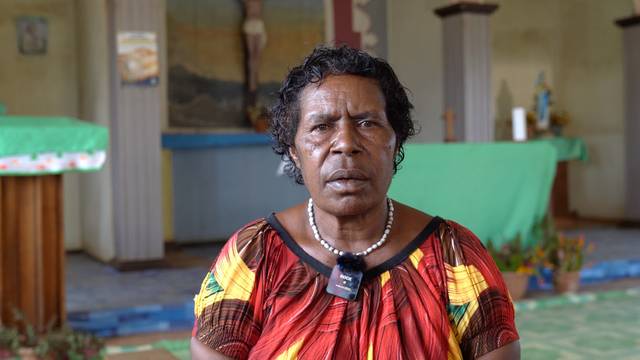
“I must be a role model now; I must make use of my training.”
Noreen Thomas, community leader and Community Curriculum participant, Tigiri, Southern Highlands Province
Noreen Thomas describes refusing an accusation after her daughter's death, when others wanted to blame someone.[9]
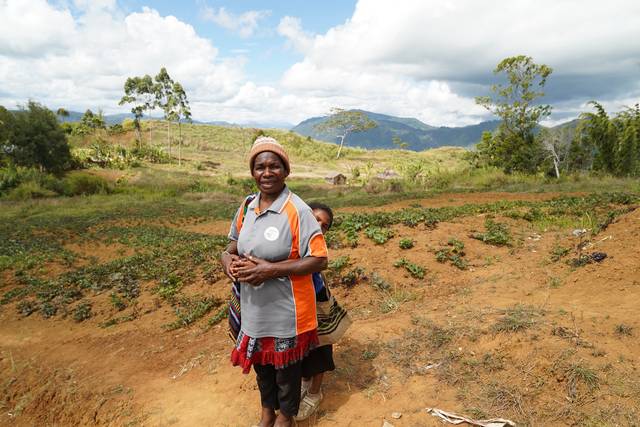
“We are protecting the generations to come.”
Margaret Lord, Community Curriculum facilitator, 2026
As quoted on the SVRI 2026 poster.[9]
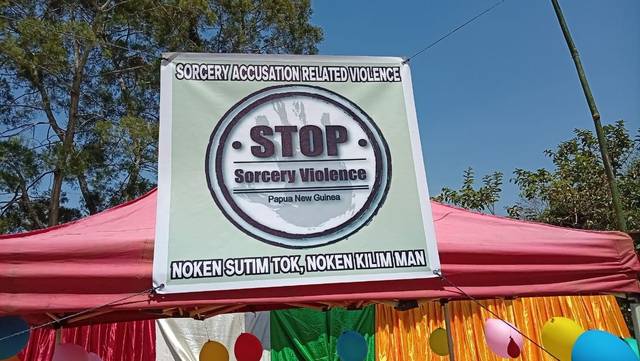
“Noken sutim tok, noken kilim man.”
In this context the Tok Pisin means “Don't accuse, don't kill.” The words were painted on a hand-made banner at the Lower Asaro graduation in Eastern Highlands Province on 22 August 2026.[8, 21]
From the survey forms
Participants wrote their answers by hand, mostly in Tok Pisin. These excerpts are from endline forms, written after the seventh session. Writers are not named.[18]
“Mi yet, nau tingting strong long traim stap namel na traim long toktok long liklik way bilong lo stoppim na helpim ol suspects. Bai mi mas tokim ol family blomi na ol pikinini man bilong mi long noken involve. […]”
“I myself am now determined to try to stand in the middle and to talk, in a small way, about the law, to stop it and help the suspects. I must tell my family and my sons not to get involved. […]”
Man, Simbu (ref. V1)
“Tok sanguma i no tru. bai mi sanap baksait, / so sapotim ol lain wer ol saspek bilong ol.”
“Talk of sanguma is not true. I will stand behind them, and support the people they suspect.”
Man, Jiwaka (ref. V2)
“Nau mi kisim training Pinis, Taim ol lain laik tok-tok long posin/sanguma bia mi tok nogat Em ol tok giaman tasol […]”
“Now I have finished the training. When people want to talk about posin or sanguma, I will say no, it is only lies. […]”
Simbu (ref. V3)
“Because mi yet em lida na student blo PNG lo Communities United Against SARV so bai mi step in huriap na savim”
“Because I myself am a leader and a student of PNG Communities United Against SARV, I will step in quickly and save them.”
Eastern Highlands (ref. V4)
“Yes ol i bin blaminim 2pla mane after long die blo 1 pla Meri, na ol youths Organize long kilim 2pla, but, mipla ol Church Lidas na community lidas step in na sotim out em current situation.”
“Yes. They blamed two men after the death of a woman, and the young men organised to attack the two of them, but we, the church leaders and community leaders, stepped in and sorted out the situation.”
Eastern Highlands (ref. V5)
About these quotations and translations
V1 omits a final sentence repeating the commitment to help if trouble arises. In V2, the slash marks a line break. In V3, posin refers to sorcery; the omitted closing line concerns correcting people's thinking. In V4, savim means save or rescue. In V5, kilim can mean beat or kill; “attack” preserves that uncertainty.
Tok Pisin is reproduced as written on the form, including spelling and punctuation; […] marks omitted text. English translations are by the programme team and were checked against the Tok Pisin. The accounts are participants' own reports; events have not been independently verified. Reference codes link excerpts to the programme's source records.
How people describe themselves
During the 2025 trial, facilitators reported participants calling themselves protectors, truth-tellers and “gardeners of peace”. Their accounts included restraint and willingness to help.[12] In 2026, participants described themselves as volunteers, role models and “the example”. Communities in several provinces asked for the course to be repeated or extended.[21]
Participants connect the course with a responsibility to act and to teach others. Read how communities are taking the work further →